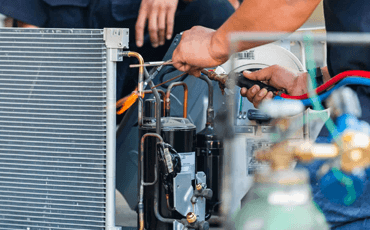
Unplanned outages cost time, money, and customer trust. The solution is a balanced critical spares plan that keeps chillers, package units, VRF/VRV, AHUs/FCUs, and cold rooms running. This guide lays out the must-have parts, stocking levels, and documentation your FM or maintenance team should adopt across sites.
Keep the controls alive and motors protected. At minimum, stock:
• Contactors, overload relays, control relays, timers
• Run/start capacitors (match µF and voltage), potential relays
• Thermostats, sensors, pressure switches (HP/LP), flow switches
• Control boards (common SKUs for your installed base), fuses/MCBs, SPDs
• VFD spares: keypads, fans/filters, DC bus capacitors (as per OEM recommendation)
Airflow issues are the #1 performance killer. Keep:
• Fan motors (common HP/kW and frame sizes), blower wheels, belts & bearings
• Filters: pre/pleated, bag, HEPA where specified; maintain a reorder point by area/usage
• Vibration mounts, flexible connectors, anti-vibration pads
• Drain items: pans, pumps, float switches, condensate hose & fittings
For safe, compliant refrigeration work, stock:
• TXVs/EEVs, solenoid valves, sight glasses, filter driers, accumulators
• Service valves, Schrader cores, access fittings, charging hoses
• Leak detection dye/kits, nitrogen/regulators, vacuum pump oil
• Refrigerants per approved list (storage & handling per local regs)
Downtime often equals a missing fitting. Maintain:
• Copper tubes & elbows/tees, reducers, brazing rods, flux & insulation
• Sealants, PTFE tapes, thread lockers, gaskets & O-rings
• Mounting hardware: anchors, bolts, brackets, strut/channel & spring nuts
Stocking full compressors depends on site criticality. For mission-critical assets, hold at least one
OEM or approved equivalent for common models, with:
• Start components and gasket kits
• Oil type per OEM (POE/MO, grade/viscosity)
• Crating/handling plan and lifting points noted
Use a simple A-B-C approach:
• A (Critical): failure stops cooling—keep 1–2 units per common model/site
• B (High): degrades performance—keep 2–4 weeks’ usage
• C (Routine): predictable replacement—keep 4–8 weeks’ usage or vendor VMI
• Datasheet & installation notes • Model compatibility list • Warranty/return policy
• Electrical ratings (µF/HP/Voltage) clearly labeled • Refrigerant & oil compatibility
• Batch/serial tracking (QR/barcode) • Authority/standard compliance where applicable
• Climate control: protect electronics and capacitors from heat & humidity
• First-In-First-Out (FIFO) for perishables (oils, sealants, filters)
• Shelf testing: periodically test capacitors/sensors; rotate V-belts
• Safety: segregate refrigerants; secure cylinders; MSDS available on site
Share your BOQ/asset register and maintenance intervals. We’ll build a tailored spares matrix with OEM or approved equivalents, lead times, and phased delivery to match your schedule.

We power projects across the UAE with quality electricals, lighting, HVAC spares, fibre optics, and generators—delivered on time with expert support.